

Digital nomads are trying to reverse the reputation
Some digital nomads are looking to make a positive difference in the local communities they visit – in their own personal and creative ways.

Hello readers — after a bit of a dry spell on Table Talk topics, I decided to share a long-form feature I wrote in Fall 2024. I hope you enjoy! I’ll be back next week with more life realizations & lessons :)
Seventeen-year-old Aušrinė Pudževytė painted cactuses on the wall and picked the brightest green she could find to paint tables and heaters. When she finished, she stepped back and examined her work. A teacher at the school walked by, curious as to who had put color on the walls that had been white for so long.
“I’ve worked here for more than 15 years, and every day I pass this same empty white wall,” the woman said. “You’re creating more than art. You brought sun to our school.”
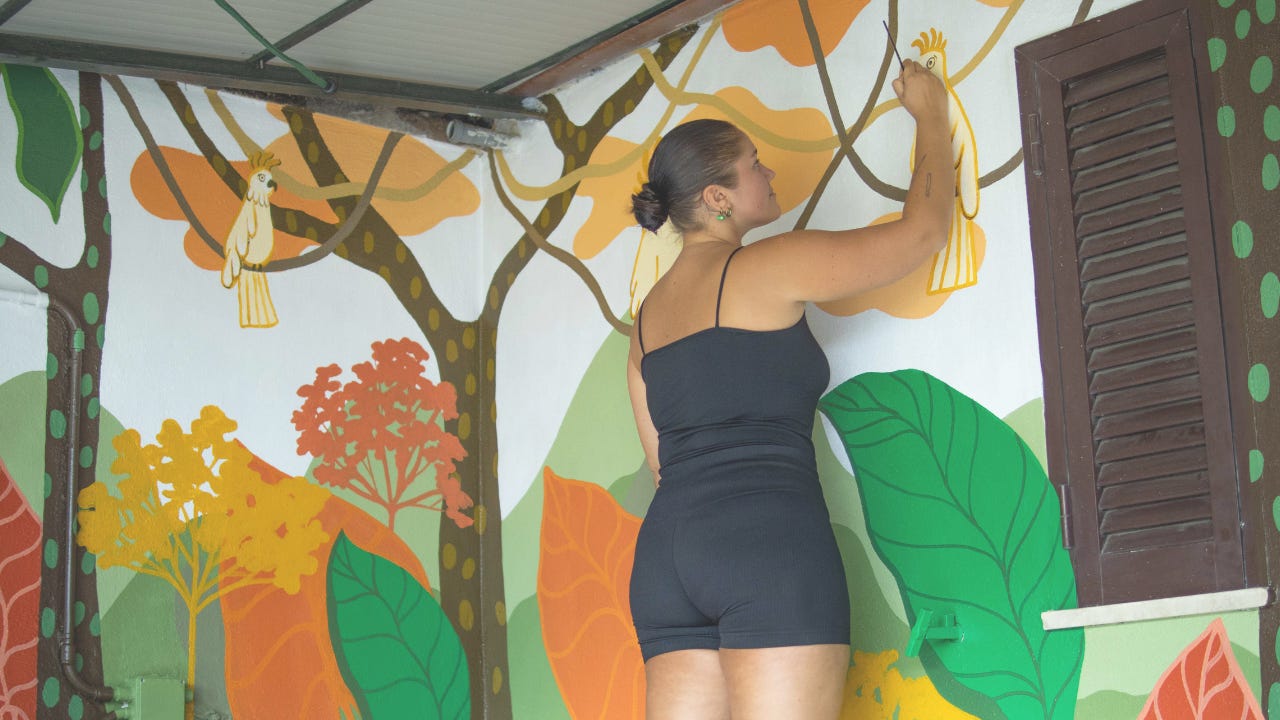
Pudževytė had traveled to Finland for a three-week internship at a construction school, where she concreted floors and put in tiles, but dreamed of sweeping her brushes across blank canvases. If this was the closest that she could get to artistic, so be it.
But the teacher’s comment awakened something in Pudževytė. She wanted more. She wanted to travel. She needed a purpose.
“I can bring that sunshine to every part of the world,” Pudževytė thought. She would be a traveling artist, a digital nomad, and she would have a mission: in her travels, she would make sure to leave positivity in every space she encountered.
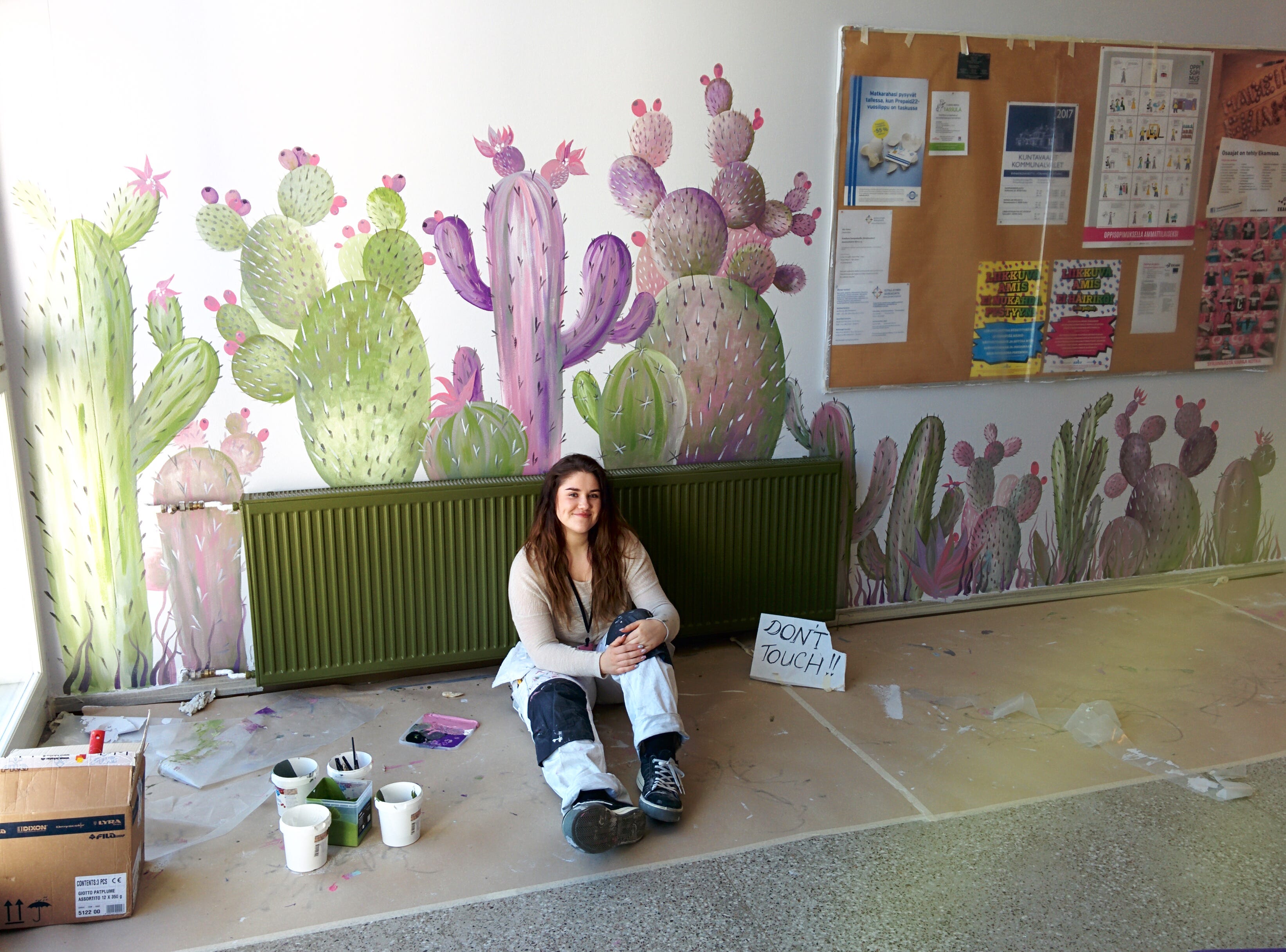
Pudževytė – 17 at the time – posing in front of her cactus mural, painted in Finland during her internship.
Digital nomads travel the world, working remotely, either for a company or themselves, often with no permanent home. The lifestyle was recognized as a mainstream phenomenon in 2014, according to a historical examination of digital nomadism. One in ten U.S. workers is a digital nomad. The lifestyle is rising in popularity, but there’s a large problem – they have a bad reputation. Many digital nomads do not interact with local communities, and they are blamed for increasing rent prices in many major cities that have become nomad hotspots.
The COVID-19 pandemic drove the growth of this lifestyle. Since 2020, the number of American nomads with traditional jobs has tripled, reflecting the rise of remote work during the pandemic. Despite recent back-to-the-office mandates, digital nomadism continues to grow. Recent growth is driven by members of Gen Z, who make up one in four digital nomads. This generation’s presence is only expected to increase as they age into the workforce.
Sixty-six countries have enacted digital nomad visas, most lasting 12 months, granting nomads the ability to maintain a “home base” while traveling. These extended visas boost local economies by allowing foreigners to live there for prolonged periods.
There are positives and negatives to countries’ hosting of digital nomads. And countries continue to invite these working travelers because of their economic contributions.
Olga Hannonen, an honorary research associate at the Department of Geography at the University of London, believes that digital nomadism’s benefits for countries are largely economic.
“Many destinations see digital nomads as a group of visitors who can inject economic benefits, especially during so-called low season, when inflow of tourists is low,” Hannonen said.
Portugal hosts tens of thousands of digital nomads, which has caused a significant increase in local rent prices. Housing prices in Portugal doubled between 2015 and 2023, particularly in the city of Lisbon.
But Hannonen clarifies that the rent crisis in Lisbon is not caused solely by digital nomads.
“Digital nomads contribute to already existing housing issues in places like Lisbon,” Hannonen said, “but they are not the initiators of these issues.”
Still, digital nomads' salaries tend to be higher than those of locals in Lisbon. So as they searched for apartments, rent prices rose, causing controversy and pushback.
Some digital nomads are aware of this controversy. They know that their lifestyle can hurt locals. And they are actively trying to make a positive impact.
To create an alternative narrative, some nomads are using coliving spaces and developing first-name basis relationships with local restaurant owners. They want locals to know they value the diversity of their cultures and the bustling of their cities. Most of all, they want them to know they are actively making choices to be a part of changing the landscape rather than contributing to the problems.
Pudževytė is now 26, on the older end of Gen Z, and started traveling as a digital nomad when she was 18.
“I went to Indonesia in Bali islands for four months, and that’s where my journey started,” Pudževytė said.
There she found locals who were willing to exchange accommodation, food, experiences, and activities for her art. She now calls herself a traveling artist, specializing in visual art, mural creation, painting, and digital art, such as content creation.
Pudževytė tries to spend at least three months in each location – she believes it takes at least that long to truly get a sense of a culture. Sometimes three months becomes half a year. This is what happened on a volunteer trip to Tanzania in 2018, which turned into half a year of traveling the entire continent. She calls the countries of Africa her “second home.”
Pudževytė knows about the economic effects of digital nomadism on local communities. Still, she believes in people’s rights to live and work from wherever they desire.
“I saw from my own eyes after COVID-19 how things just drastically changed,” she said. “People stopped wanting to live in their countries and work in the office. I think people really understood what their nature is: to explore, to discover yourself, to not be attached to one specific location or destination, including myself.”
She says that a trip is considered a good one only if she gets to know local people. But she admits that people in some countries are not as open to interacting, which can make it difficult.
On a personal level, the positive impact Pudževytė is trying to leave in each country is her murals, and teaching people that they, too, can be artists by hosting local workshops. She calls it “using my superpowers.” Every mural she creates tells a story, from meeting families to millionaires. So far, Pudževytė has left art in 28 countries.
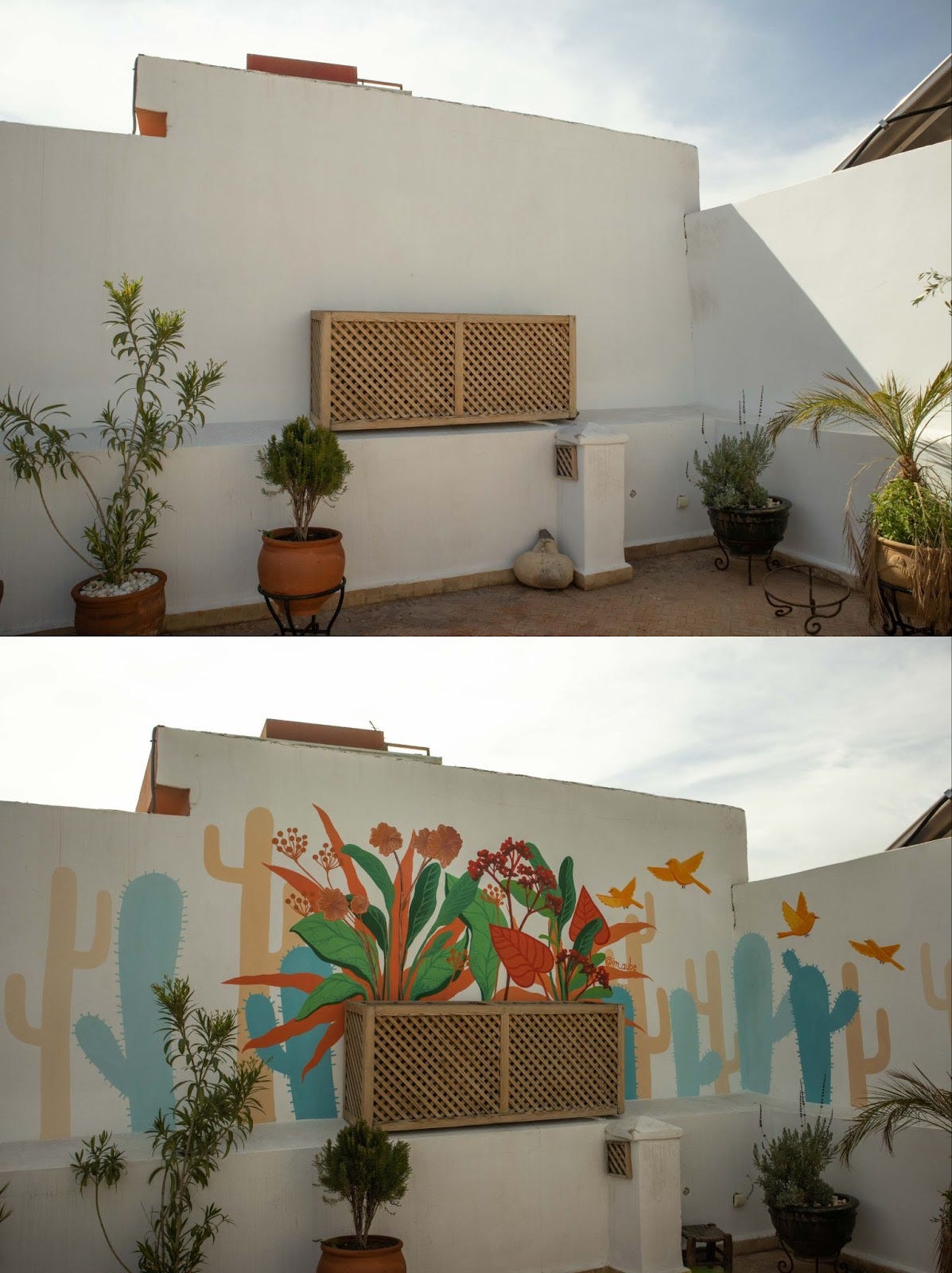
A before and after photo of one of Pudževytė’s murals in Marrakesh, Morocco.
Another digital nomad – 34-year-old Stella Guan – is passionate about the nomad community. She is originally from China and moved to the U.S. when she was 18. She is newer to the lifestyle and has been a digital nomad for about two and a half years. Guan founded an ed-tech company called Path Unbound, which is an IU/UX design school.
She calls herself a “slowmad,” meaning she tends to stay in a country or city for at least a month or more. She emphasizes how the community is made up of all types of nomads and how it is constantly evolving. Guan has noticed that her lifestyle is sometimes seen as controversial.

To combat rising rent prices in her own way, Guan makes an effort to stay in digital nomad co-livings, which are hostel-style collaborative living spaces designed to house foreigners.
“They [locals] are not living in our building, it’s mostly for foreigners or nomads, so we’re not competing with the local housing market,” Guan said.
This year, she went on a retreat in southern Italy to a tiny village of less than 5,000 people. It was organized by a local who wanted to bring foreigners to his village.
“It really felt like we were invited by someone to their hometown,” Guan said. “We saw his parents, and everybody in the village knew us. That was really nice, and I love cultural immersions like that when it’s possible.”
Even better than the day-to-day interactions with locals, Guan said, is the schedule flexibility to do volunteer work. Organizations like Nomads Give Back, an organization that helps nomads contribute to the local communities they call home through a volunteer matching program, are just one example.
Sanne Wesselman, 39, a digital nomad from The Netherlands, volunteers as often as she can. She has been a digital nomad since 2008, before the phrase was coined. She started her marketing and web design business in Spain and decided she wanted to travel. Valencia, Spain, has been her home base for several years.
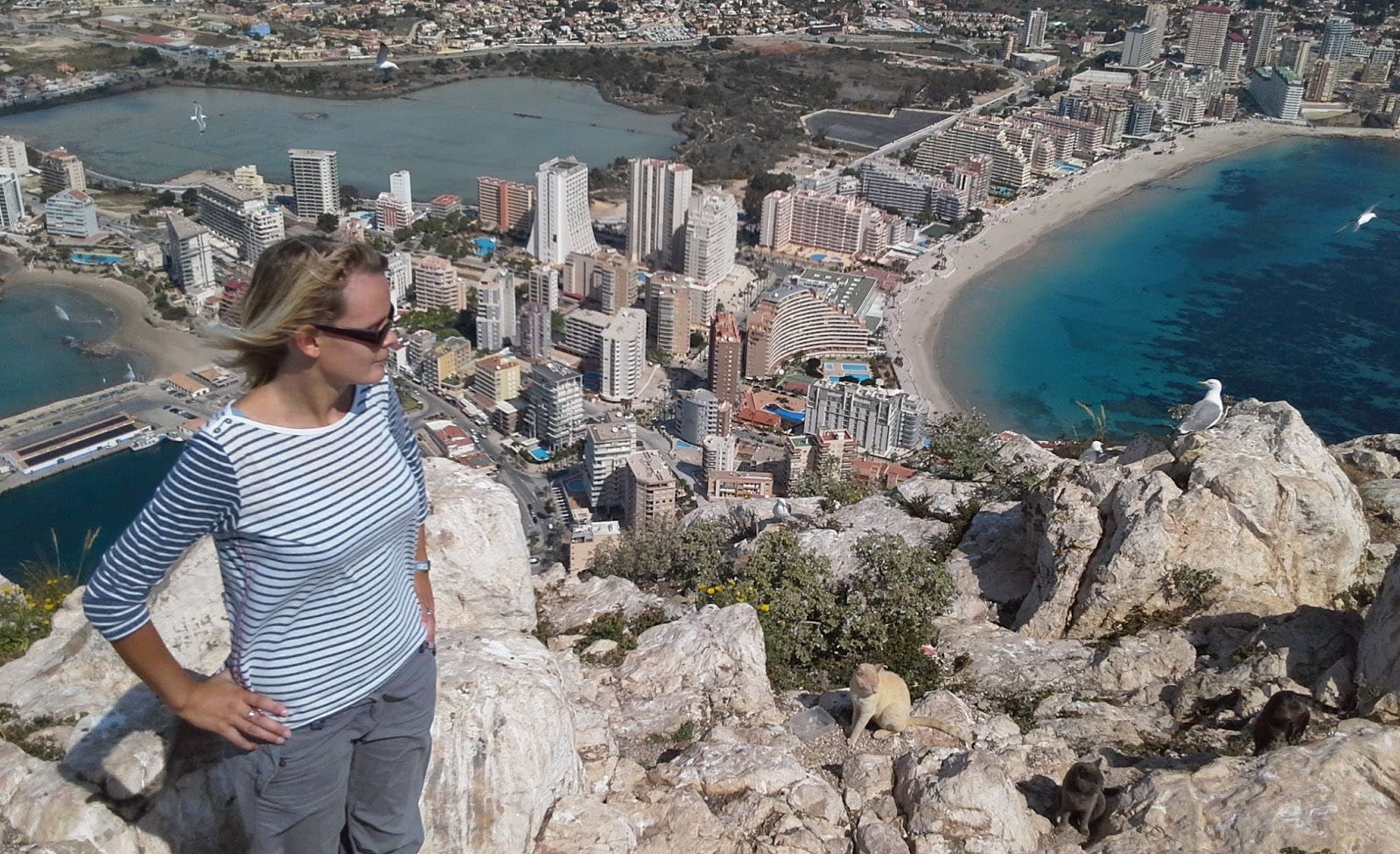
Wesselman posing in front of the city of Calpe, Spain.
Wesselman has participated in multiple volunteer co-living trips to immerse herself in local cultures and give back to communities. One of her co-living trips was to Colombia in 2018 through Venture with Impact.
“During the four weeks, they organized little day trips, weekly dinners, interaction with locals, and a tour around the city,” Wesselman said. “But what they did, and what I do really appreciate, is they organize skill-based volunteering.”
In Colombia, Wesselman was placed with a local organization called Fundación Huellas, which helps displaced people and refugees. She helped redo its website (which is now redone again, Wesselman made sure to clarify) and held marketing training sessions for the staff. She got to know a group of Colombian staff, mostly volunteers, and was inspired by their passion and dedication to making a difference.
On a smaller scale, Wesselman tries to shop locally, join local events, and interact with locals whenever she can to share stories and cultures. But she knows her desire to volunteer and give back makes her an exception.
“I know digital nomads who have absolutely no interest in interacting with the local community,” Wesselman said. “They just want to go to, let's name a cliche, Bali, where they can live cheaply, drink cocktails on the beach, and get their work done.”
Wesselman clarifies that there’s nothing necessarily wrong with that; it’s their life. They are spending money in local economies, so financially, they’re contributing to wherever they go. The World Economic Forum confirms this, emphasizing that digital nomads' ability to spend money locally has created a sustainable economic model, prompting more and more countries to offer digital nomad visas.
Beverly Yuen Thompson, a professor of Sociology at Siena College and author of “Digital Nomads Living on the Margins: Remote Laptop Entrepreneurs in the Gig Economy,” has seen evidence that digital nomads don’t serve communities in any positive way.
“In my research on digital nomads, I was disappointed to see that they did not serve any community but their own,” Thompson said. “And they actively segregated themselves off from any local populations.”
Thompson explained that nomads are also often seeking ways to avoid paying taxes. Her findings confirm the harsh reality that not all digital nomads intend to bring positivity to the local communities they call their temporary homes.
Recently, Wesselman talked with a friend who considers themselves more of an expat (someone who has moved to a foreign country on a more permanent basis). The friend asked, “Are you ever surprised that the Spanish are still happy with us?” Wesselman has seen rent prices rise in Valencia – her somewhat home base – and she knows digital nomads are blamed.
“We are seen as the cause of prices going up,” Wesselman explained. “I still can't really say that someone has said something negative to my face, but I'm waiting for the day that that happens.”
But digital nomads like Pudževytė, who wants to leave beauty in every country; Guan, who prioritizes staying in co-living spaces; and Wesselman, who connects with locals through volunteer work and organized trips, are proof that some are trying to serve the communities. Some are committed to understanding and connecting with cultures. Some are aware of housing options that will help instead of worsening the housing crisis.
Wesselman often thinks of her favorite spot during her volunteer trip in the Bahamas, in a hammock during sunrise. There, she would think about the privilege she held to be able to be there, doing something that would make the world a better place, and how lucky she was to be able to work and still volunteer.
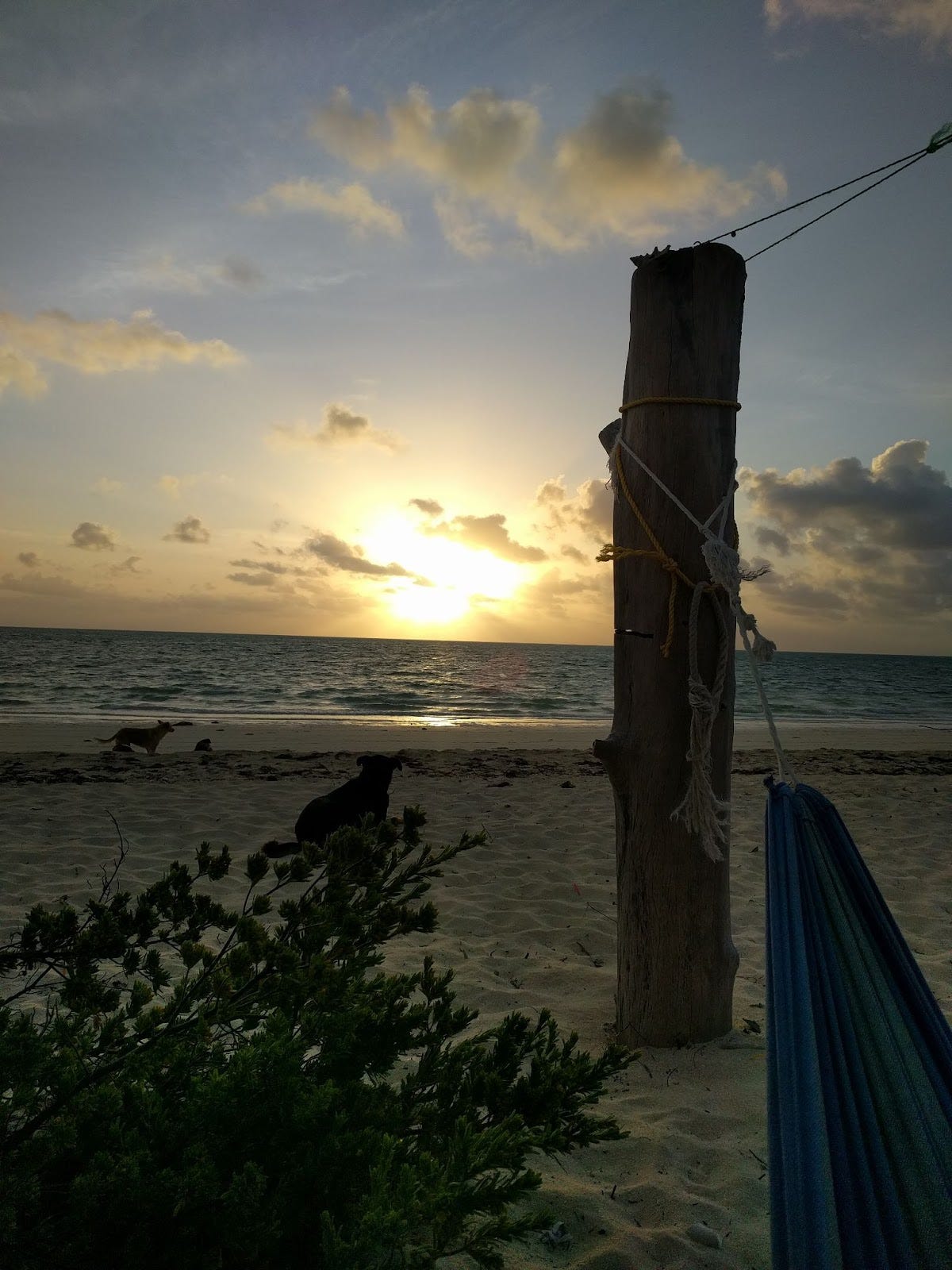
Wesselman’s favorite spot to watch the sunrise in the Bahamas during her volunteer trip.
In those moments, when her travels felt so full of purpose, she would hope that other digital nomads aim to bring about change in the world, too. That they, too, would use their flexibility and freedom for good.
This is a really interesting, in depth story Em. I am especially intrigued with the topic because my nephew and his bride, who were married last August, were “digital slowmads“ from last October through April. They spent a month in Spain, a month in Portugal, a month in France, a month over the holidays with family in Chicago, and a month on their actual honeymoon in Vietnam and Cambodia. My nephew had calculated that they would save money while traveling and living in Airbnb‘s over renting their apartment in Los Angeles. but now they’re back in California looking for a home that they can afford.